Zazen Meditation: Simply Sitting Every Day
Zazen literally means “sitting in meditation”. It is the heart of Zen: simply sitting, breathing, and being present. On this page you’ll find clear zazen instructions, explanations of zazen postures, and guidance to begin your Zen meditation practice. Where it leads? No one knows. But zazen works.
Being Present With Whatever Arises
Zazen is the form of meditation practiced in Zen Buddhism. It is cultivated to become free from suffering by realizing a calm and wakeful mind. The aim is not to solve problems, but to no longer be swept away by them. To see the world as it truly is. In zazen you learn to meet each moment without resistance: thoughts, sensations, emotions, sounds. Nothing needs to be pushed away or held onto.
How Do You Practice Zazen?
In zazen you take a stable sitting posture: on a cushion, bench, or chair. The hands rest in the cosmic mudra: one hand in the other, with the thumbs gently touching. You follow your breathing. Whenever you notice you’ve been distracted, gently return to posture and breath.
A Simple Way to Begin Zazen Meditation
- Find a quiet place where you can sit undisturbed. On a cushion, chair, or bench.
- Choose a duration. Better to do it short and regular than long and infrequent.
- Use the Zazen Timer to set your zazen period.
- Just follow your breathing.
- Be gentle with yourself: every distraction is an invitation to return. There is no right or wrong.
Joining a Zen Community?
You can certainly start practicing on your own, but joining a Zen Center is worth considering. Having a teacher and a community for support, motivation, and reflection can make a real difference. Most Zen centers are very accessible and regularly offer introductory courses. Check online to see whether there are any Zen communities or Zen centers in your area that you can join. Some Zen centers belong to a specific lineage, while others operate independently. A lineage refers to a historical line of teachers and students, passed down from generation to generation, which shapes the style, emphasis, and teaching approach of a particular Zen tradition. Exploring both options can help you find a place that matches your needs.
The Role of Rituals
The space where zazen is practiced is called the zendo. Meditation in a zendo often follows specific rituals, depending on the tradition and the particular Zen center. Rituals support the sitting practice. They focus your attention, give structure to the meditation, and create a sense of shared practice. They help you become less driven by preference or aversion, and to simply do what is being done. It is not so much about the ritual itself, but about the presence of a ritual. A form that carries the practice.
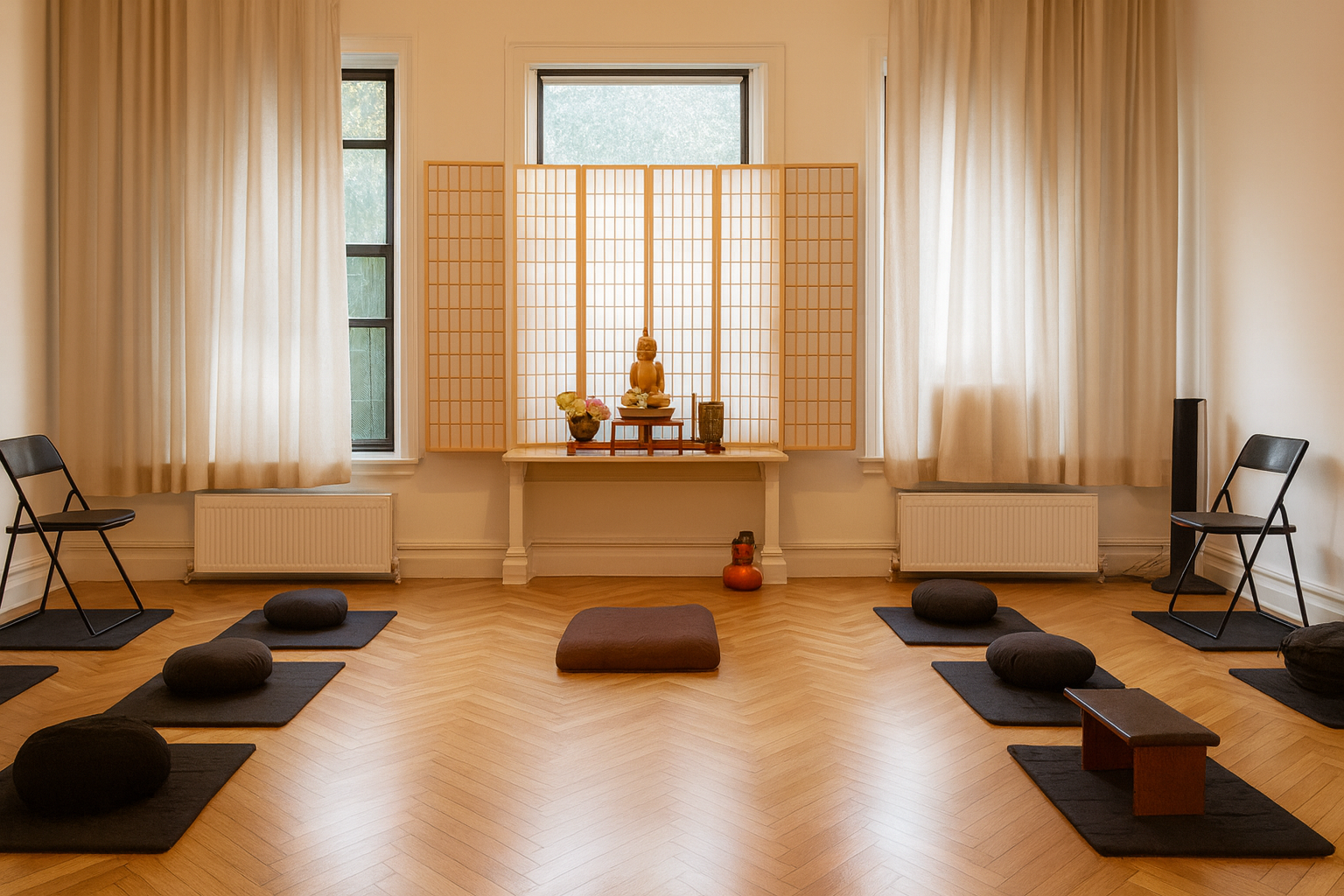
A Zendo at a Zen Center.
The Benefits of Zazen
Zazen brings you back to simplicity: sitting, breathing, being present. With regular practice, more space appears between impulse and reaction, allowing you to see more clearly and respond more calmly. It is not a method to achieve something, but a way to trust what is already here.
There is an old saying: Zen is like walking in the mist: you become soaked without noticing. The change brought by meditation is slow, but unmistakable
Scientific research supports this. Studies show that meditation can reduce activity in the amygdala, the brain region involved in stress and emotional reactivity [1] Lazar et al. (2005), Harvard University / Massachusetts General Hospital. “Meditation experience is associated with increased cortical thickness.” . Other studies demonstrate increases in gray matter in areas related to learning, memory, and emotional regulation [2] Hölzel et al. (2011), Harvard Medical School / Massachusetts General Hospital. “Mindfulness practice leads to increases in regional brain gray matter density.” . Meditation has also been shown to strengthen attention and improve emotional balance through changes in brain connectivity [3] Tang, Hölzel & Posner (2015), University of Oregon & Harvard University. “The neuroscience of mindfulness meditation.” .
Frequently Asked Questions about Zazen
What is zazen?
- Zazen is the core meditation practice of Zen Buddhism.
- It literally means “seated meditation”.
- You sit still, follow your breathing, and meet each moment as it is.
- The practice is simple, direct, and grounded in presence.
Do you control your breathing during zazen?
- No, you follow your natural breathing.
- You don’t try to deepen, slow, or manipulate the breath.
- Resting attention on natural breath helps the mind settle.
How do you practice zazen?
- Sit in a stable posture on a cushion, bench, or chair.
- Follow your natural breathing.
- When distracted, gently return to posture and breath.
- Over time, this builds clarity and calm in daily life.
What are common zazen postures?
- Cross‑legged on a cushion (full, half, or quarter lotus).
- Kneeling on a meditation bench.
- Sitting upright on a chair.
- The key is stability, relaxation, and an upright spine.
Why are rituals used in Zen practice?
- Rituals create focus, depth, and attention.
- They give structure to the meditation practice.
- They help you step out of personal preferences.
- The ritual itself is not the goal, it supports presence.
How important is consistency in zazen?
- Consistency matters more than duration.
- Ten minutes every day is more effective than one hour once a week.
- Regular practice gently shapes the mind.
- Daily sitting builds stability and presence.
Do I need a Zen teacher or Zen Center to practice zazen?
- You can start practicing on your own.
- A Zen community or teacher can offer guidance and support.
- Practicing with others deepens understanding.
- Some Zen centers belong to a lineage; others are independent.